Features
Desktop designer + target firmware runtime
One widget catalog, one variable semantics, one protocol core — the designer and firmware share the same source. The full feature landscape follows.
Desktop
DD-CAT IDE Designer
A Windows desktop app combining visual UI design, data binding, logic composition, algorithm graphs, simulation debugging, and firmware export.
Project management
- New project wizard: pick chip / board / display backend; free resolution configuration (incl. round screens)
- Headless projects: pure control logic, hiding UI editing to focus on variables and algorithms
- Project and component templates; export auto-filters template metadata
Visual canvas
- Multi-screen management, asset manager, docked component library
- Drag-to-place selection, multi-select align/distribute, guides, undo/redo
- Component grouping (16-layer real container tree) + state styles + Flex layout
Style system
- Aligned to LVGL v9 style properties: the full key set of background/border/outline/shadow/padding/transform…
- Gradients (multiple stops), opacity, corner radius, scale-compensated rotation anchors
- Color/opacity "empty = unset" semantics, identical on hardware and in simulation
Variables & data binding
- Global variable catalog + sys_* system variable family (same names on both ends)
- Widget property binding: variable / tinyexpr expression, mutually exclusive
- UDT structured JSON passthrough; dot-path binding like base.field
- Rule engine: variable changes trigger actions, with automatic storm muting
Logic & algorithm composition
- Algorithm graph editor: 48 blocks, drag-and-connect, fixed-point parameters, export validation gate
- Flow editor: state-machine node composition
- JS engine: gx.uart/can/spi/i2c bus APIs read and write hardware directly
Simulation & debugging
- One-click built-in simulator with real widget rendering through the full pipeline
- Simulation console: sim connect for remote linking, sim vars/set to read/write variables remotely
- Bus TCP interop: virtual UART/CAN/SPI/I2C bridge to real hardware gateways
- Comm Inspector: synchronized HID packet capture on both ends
Export & update
- One-click app package export (MIB1 container .bin) + pre-export validation gate
- Standalone online updater: one-click check, incremental download, verified install
- Chinese/English bilingual UI (full i18n)
- Import SquareLine (.spj) projects
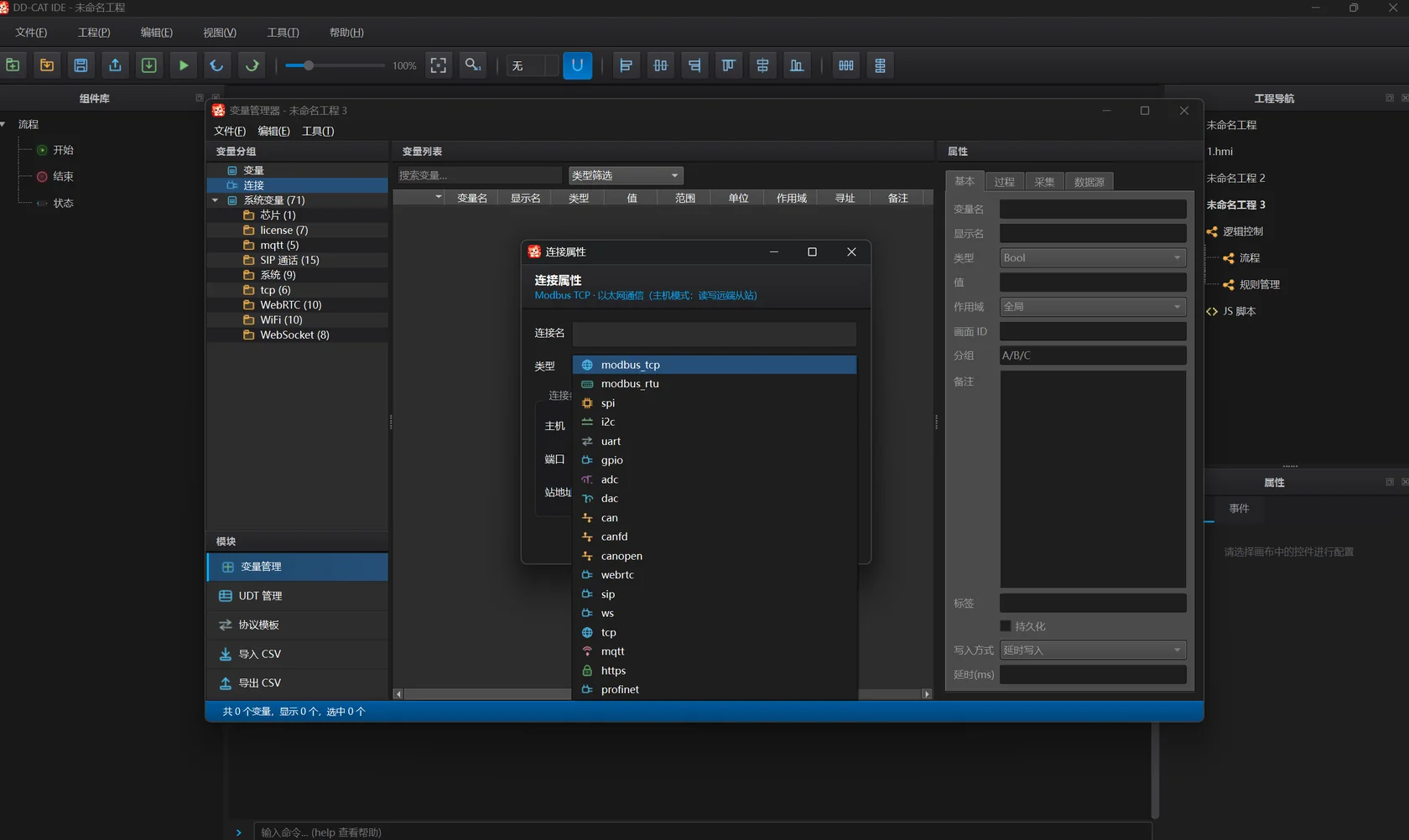
Connection config: fill parameters and connect
The designer’s connection dialog provides per-type parameter forms; firmware varsrc and the desktop simulator match by key — configure once, identical in simulation and on hardware.
| Connection type | Use case | Typical parameters |
|---|---|---|
| mqtt | IoT cloud | server / port / user / pass |
| tcp | Transparent transport (JSON-lines frames) | host / port + key addressing |
| http / https | REST fetch, JSON into variables | url + json_path |
| websocket | Bidirectional channel | host / port |
| modbus | Modbus RTU / TCP master/slave | serial / baud / station ID |
| canopen | CANopen bus | node / object dictionary |
| profinet | Industrial Ethernet | device name / IP |
| sip | Voice/video calling / intercom | server / user / pass / audio codec |
| webrtc | Real-time audio/video / data channel | host / port / token / AV toggles |
Target
Embedded HMI firmware runtime
A chip/RTOS-agnostic MCU host that loads exported app packages to reproduce the designed UI and logic on real hardware.
Overall architecture
- Chip/RTOS-agnostic MCU host; board capabilities injected through contract interfaces
- Layered: L0 PAL/OSAL → L1 contract → L2 runtime → L3 UI backend → L4 app package
- Strict C89 + industrial-grade safety subset (-Wall -Werror)
- Four macro trim tiers: tiny/small/medium/full, down to display-free pure control
UI runtime
- LVGL widget factory + screen manager; load the app package to reproduce the design
- LVGL 9.1 / 9.5 / GUIX backends, one widget catalog across three ends
- Full GB2312 Chinese font set, image decoding, MJPEG/network-stream video playback
- Touch navigation, screen gestures, Pinyin input
Variable engine
- Full pipeline: variable load / binding / rule execution
- Rate storm gate: cascaded strict thresholds + wide source-write thresholds; mute and hold on exceed
- Per-tick budget control for batch dispatch; VAR_STORM fault code propagated
Protocol stack
- MQTT 3.1.1 client (QoS 0-1, wildcard subscriptions)
- TCP transparent channel (JSON-lines frames, backoff reconnect)
- HTTP/HTTPS fetch, WebSocket bidirectional channel
- Modbus RTU/TCP, CANopen, PROFINET, local IO
Voice & video calling
- SIP stack: RFC3261 four-state transaction machines + Timers A–K, digest auth
- SDP offer/answer negotiation; G.711 fallback + high-quality Opus (bit-exact on both ends)
- WebRTC: ICE-lite/STUN subset + SRTP (AES_CM_128_HMAC_SHA1_80) encryption
- Camera DVP capture pushed straight to the peer; typical for video intercom/access control
Algorithm graph runtime
- Generic descriptor-driven interpretation; fully declarative block definitions with fingerprint rejection
- Motor control: FOC/SVPWM/SMO/SMC/HFI/PLL/MTPA
- Digital power: Buck/Boost/LLC/PFC/DOB/DPCC
- Hardware-decoupled: all peripheral interaction goes through the variable manager
Security & licensing
- 1-Wire chip license token (LIC-CTA): unique chip key as trust anchor, anti-clone
- Unauthorized = fail-closed; factory programming tool included
- Three-level macro configuration for the license pin
App packages & OTA
- A single .bin app package bundling UI + logic + algorithm graphs + hardware config + assets
- Package load state machine + integrity check + four auto-matched capability tiers
- OTA: filesystem staging → verify → switch-over, with rollback on failure
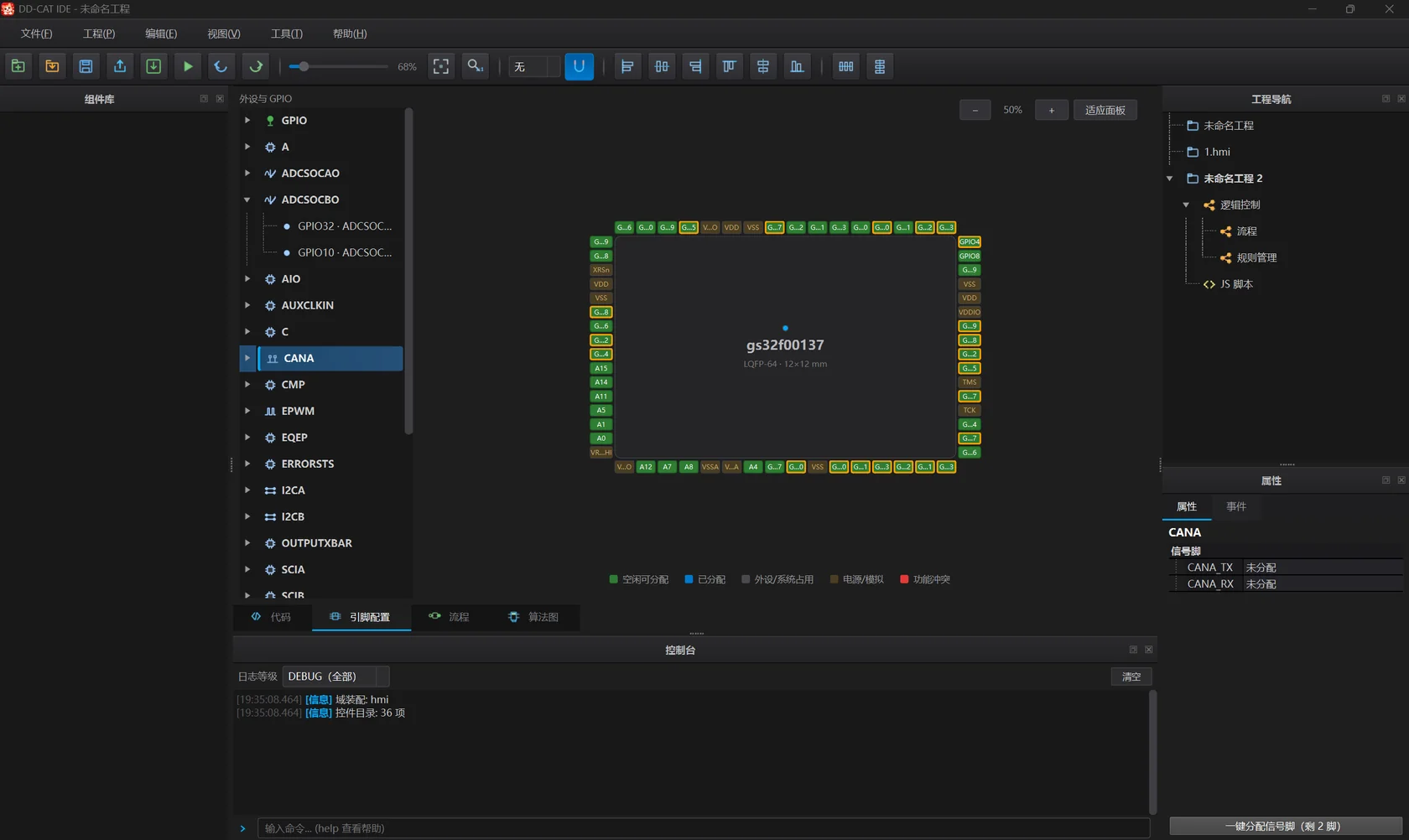
Pin configuration that truly drives hardware
Per-pin assignment in the chip view, color-coded across five states (free / assigned / peripheral / power-analog / conflict); board schemes auto-check conflicts. The config ships in the app package and firmware initializes pins as declared.
- · Full peripheral coverage: GPIO / UART / ADC / DAC / CAN / CAN-FD / I2C / SPI / PWM / EQEP
- · Peripheral capability bits come from the chip pack; new projects auto-filter